Run as Administrator
Table of Contents
When operating your computer with Command Prompt, some operations require administrator privileges.
For example, when modifying files in system folders such as C:\Windows from Command Prompt, administrator privileges are required.
Also, when installing software from Command Prompt, administrator privileges may be required.
There are several methods to launch Command Prompt with administrator privileges, but here we will explain two methods.
Quick Reference: Ways to Run as Administrator
| Situation | How |
|---|---|
| Fastest way | Windows + R → type cmd → Shift + Ctrl + Enter |
| From the Start menu | Windows → type cmd → click “Run as administrator” (or press Shift + Ctrl + Enter) |
| From the Win+X menu (right-click the Start button) | Windows + X → “Terminal (Admin)” on Windows 11, or “Command Prompt (Admin)” / “Windows PowerShell (Admin)” on Windows 10 (in PowerShell, then type cmd) |
| Start menu does not respond | Ctrl + Shift + Esc to open Task Manager → “Run new task” → cmd → check “Create this task with administrative privileges” (on Windows 10, expand “More details” first) |
| Switch from an already open cmd | powershell -Command "Start-Process cmd -Verb RunAs" |
To confirm you have administrator privileges, check that the title bar says “Administrator: Command Prompt”, or run net session (see the confirmation section at the end of this page).
The rest of this page explains the “Run” dialog and Start menu methods with screenshots.
1. Launch from “Run” Dialog
In Windows, various programs are pre-installed, and one way to launch these programs using text strings is the “Run” dialog. This applies not just to Command Prompt but to other programs as well.
For details on how to launch Command Prompt using the “Run” dialog, please refer to the following page.
However, the normal method cannot launch Command Prompt with administrator privileges.
Therefore, to launch Command Prompt with administrator privileges, do the following:
- Press Windows key + R key
- Type
cmdin the displayed “Run” dialog - Press Shift key + Ctrl key + Enter key
- Command Prompt launches with administrator privileges
Press Windows key + R key
Pressing Windows key + R key displays the “Run” dialog.
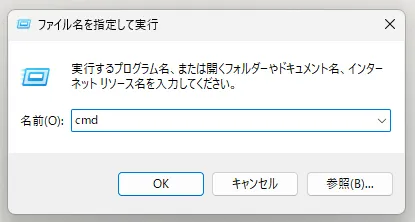
Launch with Shift key + Ctrl key + Enter key
Shift key + Ctrl key + Enter key is a shortcut to launch the specified application with administrator privileges.
After typing cmd, the string to launch Command Prompt, pressing Shift key + Ctrl key + Enter key will launch Command Prompt with administrator privileges.
Command Prompt is Displayed
Once Command Prompt appears, the launch is complete.

2. Launch from Start Menu
For details on how to launch Command Prompt from the Start menu, please refer to the following page.
However, similarly, the normal method cannot launch Command Prompt with administrator privileges.
Therefore, to launch Command Prompt with administrator privileges, do the following:
- Press the Windows key
- Type
cmdin the displayed Start menu - Launch using one of the following methods:
- Press Shift key + Ctrl key + Enter key
- Click “Run as administrator”
- Command Prompt launches with administrator privileges
Press the Windows key
Pressing the Windows key displays the Start menu and puts it in a state ready to accept input.
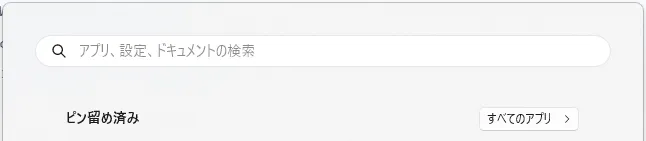
Launch with Shift key + Ctrl key + Enter key
Once the Start menu is displayed, type cmd.
While it requires more characters, you can also type “Command Prompt” to display it as a candidate.
With the display shown in the image, pressing Shift key + Ctrl key + Enter key will launch Command Prompt with administrator privileges.
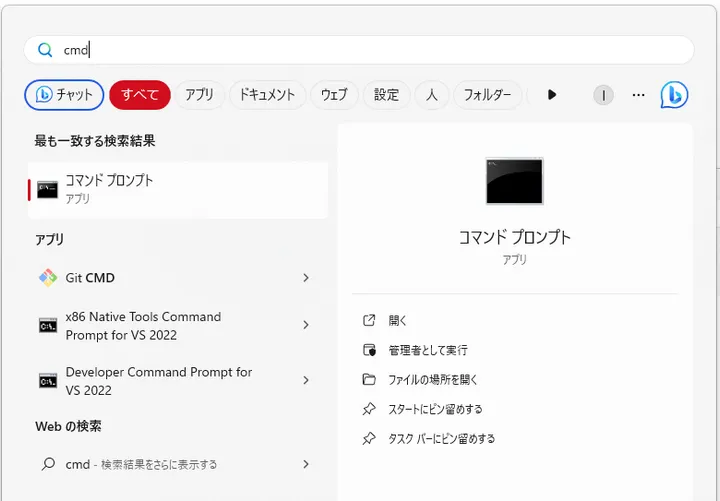
Click “Run as administrator”
Alternatively, when Command Prompt is displayed in the search results, you can right-click it or click “Run as administrator” on the right side to launch it with administrator privileges.
Command Prompt is Displayed
Once Command Prompt appears, the launch is complete.

中小企業経営者のためのRPA入門 RPA導入を成功させる方法

60分でわかる! AIエージェント 超入門

コマンドラインの黒い画面が怖いんです。

知識・才能ゼロでもらく~に月10万円稼ぐ! よくわかるAI副業超入門
Confirm that it is running as administrator
A Command Prompt running with administrator privileges shows “Administrator: Command Prompt” in its title bar.
If a “User Account Control” dialog appears at launch, select “Yes”.
Confirm with a command
If the title bar is hard to judge, run net session. With administrator privileges it shows a message such as “There are no entries in the list.”; without them it fails with “Access is denied.”
A Command Prompt launched as administrator starts in C:\Windows\System32.
Use the cd command to move to your own folder before working there.
You can also press the Windows key + X key and choose “Terminal (Admin)” from the menu. By default this may open PowerShell instead of Command Prompt.